Selasa, 10 Januari 2012

Acupuncture as a Method of Traditional Chinese Medicine (TCM)


          Chinese state is a country known for its treatment, China continued to maintain and preserve the legacy of China's treatment of the era about 5000 years ago, one of the methods of traditional Chinese medicine is acupuncture, acupuncture is a type of alternative medicine that treats patients by inserting a thin needle to the skin at the body, according to the type of disease suffered by the patient.

            Acupuncture needles are usually made of stainless steel wire, usually disposable, needle length varies between 13-130 millimeter, short needle is used near the face such as eyes, a long needle in the area being more fleshy, needle diameter varying from 0.16 to 0.46 millimeters . In addition to regular filiform needles, there are also other types of needles that can be utilized, such as three-eyed needle and Nine Ancient Needles. Japanese acupuncturists Using a very thin needle is used shallow, sometimes without penetrating the skin, dandikelilingi by guide tubes (a technique adopted in China and the West). Korean acupuncture using needles of copper and has a greater focus on hand.          Body functions regulated by the flow of energy called Qi entities, acupuncture aims to improve the balance in the flow of Qi by stimulation of anatomical locations on or under the skin called acupuncture points. Traditional Chinese medicine (TCM) is not only to distinguish one type but several Qi, Qi in the general sense is something that is defined by the five "cardinal functions" namely:1. -Actuation of all the physical processes in the body especially the circulation of all body fluids such as blood in the veins.2. Warming-body found on the legs.3. Defense against pathogenic factors exogenous.4. -Containment of body fluids, namely keeping the blood, sweat, urine, etc. excessive emissions.5. Transformation-transformation of food, drink, and breathe into Qi, Xue (blood), and Jinye (liquid).            The origins of acupuncture are unclear, many versions of the story is not yet known kebenaranya, but the initial text to describe a Chinese medical acupuncture is Huangdi Neijing, yellow emperor's classic of internal medicine legendary compiled around 305-004 BC.The practice of acupuncture expanded into areas that are now part japan, korea, taiwan.The users of acupuncture treatment methods believe that acupuncture can improve health, reduce pain, and prevent disease. Acupuncture should be administered by trained practitioners using sterile needles, because not everyone can apply the right method of acupuncture is, when one of the applicability can be fatal even to death.         In modern medicine, a form dokoter examine the tongue, pupils, bad breath, and breathing quality voices, different from the TCM and the concept of disease, they do not distinguish between cause and effect, in theory anyway, penyeban endogenous, exogenous etc. The disease is recognized. Acupuncturist decides which points to treat by observing and questioning the patient to make a diagnosis according to the tradition which he utilized. In TCM there are four methods in diagnostics: inspection, auscultation, smelling, questioning, and palpation. Examination focuses on the face and especially on the tongue, including analysis of the size, shape of the tongue, color tensions, and the absence or tooth marks around the edges. 

Senin, 09 Januari 2012

Kecak Dance Balinese art and culture of origin "cak cak"


Bali is an island rich in art culture, one of which is the Kecak dance, dance is very popular in foreign countries even exist Cakolosal event with 5,000 male dancers who dilaksananakan on 29 September 2006, the main purpose Cakolosal is to allow everyone the district to deliver a message of peace to the world by using the concept of mutual cooperation. 

Back to the discussion Kecak dance, Kecak dance was created sometime in the 1930s by Wayan Limbak collaboration with German photographer Waterspies, Wayan Limbak promote Kecak dance while traveling the world in foreign countries along with the return of a group of dancers.
In its pure form Kecak dance is performed religious ceremonies sometimes for several hours at night around 18:00 hours in a row, for 4 months to ward off evil and danger during the pestilence, but at this moment Kecak dance performed for entertainment. Kecak dance is very popular show in Bali and was always full of spectators, the only outdoor show with a gorgeous sunset view, Kecak dance can be found in several places in Bali.
Thousands of visitors from abroad come to see the Kecak dance which is very unusual, Kecak dance is played mainly by men, this dance performed by dozens of even more male dancers who wear cloth squares like a chessboard, which is typical of Balinese cloth. Kecak Dance does not use musical instruments but only use krincingan used male dancers, male dancers all at once called for "cak cak cak cak" with a fast rhythm and raised both arms of the tarianya called Kecak dance. Dance Kecak Ramayana describes the story of the time line of apes helped Rama fight the Ramayana.
Kecak dance originated from sanghyang dance, this dance tradition the dancers perform a dance in an unconscious condition, aim to communicate with the gods or ancestral spirits, and expressed his expectation to the public.
Coming to the island of the gods is not complete if you do not see this phenomenal dance.

Minggu, 08 Januari 2012

Korean Tripitaka UNESCO world cultural heritage

         Tripitaka means a collection of all the manuscripts that were taught by the Buddha, and because of the Tripitaka was made during the Goryeo dynasty called Goryeo Daejanggyeong which is used as a world cultural heritage by the organization of education, knowledge, and cultural union of the nations (UNESCO) and its buildings tripitaka.Tripitaka Korea is the oldest wooden Tripitaka in the world, in the year 1000 BC, people Goryeo analyze and compare all the existing manuscripts, Goryeo people trying to own so earnestly to make the Korean Tripitaka to a level where they carved out one letter and prostrate before carve out another letter, the results without a single word that is misspelled or incorrect carving.


         Precision and accuracy of the Korean Tripitaka comprises about 52 million words in more than 80,000 engraved carved beams and best appreciated as a work of art carved from blocks that never existed in human history. Korean Tripitaka Haeinsa temple located in south korea in mountain gaya, founded in the year 802, with the Korean Tripitaka shrine became famous, there are also lljun dikuil-Mun one pole or the gate that separates the world of illusion of the world the truth, through the gates brought us toward the spiritual world through the physical world.
         

        Janggyeong panjeon Korean Tripitaka place wooden blocks consisting of four sruktur, this building also is a UNESCO cultural heritage, although banguna designed to look simple but wise to keep the carving block. Outer wall has a lower window that is four times greater than that above it, while the wall on the other side has a window on a larger and a smaller bottom window that serve as air vents evenly and well. On the inside of this building there is an upper floor coated charcoal, chalk powder, and salt all of these aims to be able to control the temperature including humidity, natural ventilation systems are adapted to climatic conditions and thus can keep the Korean Tripitaka that can last up to 500 years and undamaged.
Types of Buddhist texts engraved in Korean Tripitaka are all numbered 1538, the number of books about 6844 pieces and about 80000-81258 a well-crafted wooden beams on the 10 pole rack. To keep the wooden beams so as not to crack, eucalyptus trees soaked in seawater for 3 years, the next trim and boil again in salted water before being dried shady place later letters were written with a brush before it was carved, on wooden blocks carved after coated with varnish in order not to damaged by insects.
The woodblock Tripitaka Haeinsa compared to the authority of the Buddha are defended as against Mongolian, they are recognized by Buddhist scholars around the world for their exceptional accuracy and superior quality. Chinese Buddhist Tripitaka Koreana has also been used as reference in their compilation. Houses woodblock Haeinsa deposit most complete and accurate version of the Buddhist scriptures in the world, they are famous pilgrimage destination, not only among Buddhists but also Korean Buddhists around the world.
In each year in the temple courtyard Haeinsa held a meeting of the dharma, the event is a meeting of Korean Tripitaka Dharma for the sake of protection against the state.
Thousands of devotees revolves around the page carrying the shrine that contains a block of wood carving Goryeo Daejanggyeong or Tripitaka korean. Until now Korean people held a peaceful procession carrying Korean Tripitaka above the head and hope for peace in his country and the world.
Bottom of Form

Sabtu, 07 Januari 2012

3 countries with the most popular traditional food


Traditional foods are most popular in asia, here the authors will discuss the three countries with their respective typical traditional foods, such as country Indonesia, Thailand and Japan.
Food Indonesia

Rendang is a dish that originated from the Minangkabau ethnic group of Indonesia, and is now commonly served across the country. One of the typical foods of Minangkabau culture, served on ceremonial occasions and for guests of honor. Also popular in Malaysia, Singapore, Brunei, southern Philippines and southern Thailand, rendang is traditionally prepared by the Indonesian community during festive occasions. Though rendang is sometimes described as like curry, and this name is sometimes applied to curried meat dishes in Malaysia, authentic rendang is not like curry. In classical Malay literature, rendang is mentioned in the Tale Amir Hamzah.
In 2011 an online poll by the 35,000 people detained by CNN International chose Rendang as the number one plate '50 Most Delicious Food World '.
Rendang is made from beef (or sometimes beef liver, chicken, goat, buffalo, duck, or vegetables like jackfruit or cassava) is cooked with coconut milk, spices and sometimes rustle (toasted coconut paste) for several hours until almost all fluid is lost, allowing the meat to absorb seasonings pedas.Perubahan cooking from boiling to frying as the liquid menguap.Proses slow cooking allows the meat to absorb all the spices and become soft.The spices may include ginger, galangal, turmeric leaf, lemon grass and chili. Chicken or duck rendang also contains tamarind and is usually not cooked as long as beef rendang.There are two kinds of rendang: dried and wet. Dry rendang can be kept for three to four months, and it is for ceremonial occasions or for guests kehormatan.Rendang wet, also known as kalio, can be found in Minangkabau restaurants and without cooling, should be consumed within one month.
Rendang is often served with rice, diamond (Indonesian compressed rice cakes), and lemang (glutinous rice baked in bamboo tubes) in Indonesia.

Thai Food

"Thai food offers a variety of flavors and tastes smooth blending herbs and spices and market-fresh ingredients makes dining a special culinary experience .."
Eating a high ranking on a scale of Thailand pleasures, and meals are informal affairs.Staple is rice, either ordinary or glutinous, accompanied by a variety of dishes that can be eaten in almost any order, and seasoned with individual taste with several condiments such as fish sauce and chilli. Most often there will be some kind of soup, curry, steamed or fried foods, salad, and one or more basic sauces. Desserts may consist of fresh fruit or one of the many traditional Thai sweets.
Century ago, the food is eaten by hand, pressing the rice into small balls, today spoons and forks are used to eating rice, while chopsticks are used for these types of Chinese noodles.

Thai food differs from region to region. In contrast to the North and Northeast, where glutinous rice is popular, central Thailand as fragrant plain variety, most commonly steamed. In addition to freshwater fish, there is seafood from the Gulf of Thailand, as well as a variety of fresh vegetables. Chinese-Thai food popular in cities like Bangkok, particularly in the form of many noodle dishes.

Central Region also has what is called the Royal cuisine, a more sophisticated version of regional cuisine. Influenced by the kitchens of the Royal Court, a complex dish put together, so as much as a work of culinary art form.

Northern Foods is typical as its culture. Steamed glutinous rice is preferred, traditionally kneaded into small balls with your fingers. Northern curries are generally milder than the central and northeastern Thailand. Influence of neighboring Burma is evident is popular dishes such as Kaeng Hang Le, pork curry that relies on ginger, tamarind, and turmeric to taste, and Khao soy, curry broth with egg noodles and meat, topped with green onions, pickled cabbage, and slices orange juice.
Traditional Kantoke Table
A particular favorite is the spicy pork sausage called naem. Traditional forms of food called Kantoke dinner guests were sitting around during a small low table. The show gala night of the royal version of Kantoke banquet can be enjoyed in the reconstructed wooden palace. This show includes a group of local dancers, resplendent in traditional costume and can be pre-ordered at this link.


"Fish River of the most popular in the Issan region" Northeastern food reflects the influence of neighboring Laos in a number of dishes. Glutinous rice is the staple, and the food is very experienced, such as larb, made with spicy minced meat or chicken. som tam (green papaya salad) and kai Yang (grilled chicken). Meat once rare in the village, and freshwater fish and shrimp are the principle source of protein, sometimes fermented.
In the South, oil plays an important role in many dishes, milk his emotional hot chilli-laced soups and curries, oils used for frying, and the scar that serves meat as a condiment.Fresh seafood from the surrounding waters is abundant: fish, shrimp, lobster, crab, squid, clams, and mussels calm. Cashew nuts from local plantations are eaten as appetizers or stir-fried with chicken and dried chillies, while the pungent flat bean called Sator add an exotic, if somewhat bitter flavor much admired by visitors to the south. Chinese-Thai food popular in big cities as well. Other foreign influences can be found in dishes like Kaeng matsaman, Indian style mild curry flavored with Cardamon, cloves and cinnamon, and sate - flesh pierced with a spicy peanut sauce that comes from Indonesia.

Japan Food
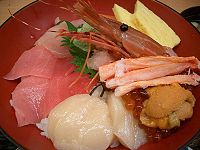
Sushi (鮨, 鲊, or usually すし, 寿司?) Is a Japanese food consisting of rice that formed along a side dish (neta) of seafood, meat, or cooked sayuranmentah. Sushi rice has a soft taste sour because seasoned mixture of rice vinegar, salt, and sugar.
The origins of sushi is said to taste sour adjectives are written with the kanji sushi (酸し). At first, sushi is written with the kanji 鲊 is the term for one type of fish preservation called gyoshō (鱼 醤?) Who smear the fish with salt, powdered yeast (koji 麹?) Or ampassake (糟 kasu). Writing kanji sushi using 寿司 that began in the mid-Edo period is a way of writing ateji (written with another kanji that reads the same).

Makizushi
Sushi rice rolls containing pieces of cucumber, another neta tamagoyaki and wrapped in nori sheets. Rice rolled with the help sudare (woven bamboo rectangular shape).
Makizushi divided into:
§ Hosomaki: roll a minimum of 3 cm in diameter contain only one kind of neta (such as cucumber or tuna).
§ Futomaki: coil diameter above 5 cm contains a wide range of neta.
§ Temakizushi: rice rolled with nori himself before eating, neta also handpicked from the plate.
There is a tradition in the Kansai region ehomaki to invite good luck on the day of the spring equinox. The rolls should be eaten Futomakizushi intact while facing the direction of the wind of fortune. When eating, people are also prohibited from making a sound or speak. This tradition was originally popularized by sushi trade association in the 1970s.

Chirashizushi

Rice is eaten with sushi neta of seafood and vegetables are cut into small pieces. Sushi rice was not formed but is loaded into the container of wood, a plate or bowl. Chirashizushi is one of the houses are popular dishes in Japan to commemorate special days like birthdays of children and Hina Matsuri celebration.
In other areas in Japan, chirashizuhi has many other names such as suzushi in Kagoshima Prefecture, Okayama Prefecture matsurizushi, tekonezushi (Mie Prefecture), there are even certain areas chirashizushi decorate with pieces of fruits like apples, oranges, and cherries.

Oshizushi

Rice prepared with neta who pressed for a while with the intention of compressing the resulting sushi rice so that the rectangle-shaped and cut into pieces to be easily enjoyed.Oshizushi there is also wrapped in bamboo leaves and pressed for a while, between a few hours until one night. The names oshizushi popular include:
§ Sabazushi containing mackerel that has several other names such as battera or bozushi Osaka Prefecture, Kyoto
§ Masuzushi in Toyama Prefecture
§ Oshizushi Funa fish from Mie Prefecture
§ Sanmazushi and Gozaemonzushi of Tottori Prefecture
§ Iwakunizushi of Yamaguchi Prefecture

Narezushi

Sushi antiquity is smeared salt fish and rice, then allowed to ferment. Funazushi of Shiga Prefecture and Akita dariPrefektur hatahatazushi sushi are two examples of ancient origin.There is also a plus narezushi yeast to aid fermentation process, for example kaburazushi of Ishikawa Prefecture and Izushi of Hokkaido.
Kaburazushi is a type of sushi that was not formed with rice. Sushi made with raw fish slices clamped between two pieces of sliced ​​radishes kabura. After that, the sushi is prepared in a wooden vat containing a mixture of cooked rice mixed with yeast Tanak.Long fermentation for several days. Kaburazushi eaten with fermented rice washing is not attached.

Inarizushi

Sushi rice wrapped aburage previously cooked with soy sauce and sugar. Inarizushi not contain fish or other toppings because aburage been a source of protein. Inarizushi comes from the temple town of Toyokawa Inari in Toyokawa, Aichi Prefecture.
Sushi Kansai region
Sushi in the Kansai region are generally more concerned with flavor blend of rice and side dishes than the freshness of the fish. Traders make sushi taste not easy to change if bought to take home. Among the typical Osaka sushi is hakozushi (oshizushi), barazushi (gomokuzushi) and various makizushi, and battera (mackerel sushi).

Sushi wrapper leaf

Mackerel sushi wrapped in tree leaves persimon of Nara and Wakayama Prefecture is the kind of sushi durable.

Jumat, 06 Januari 2012

Development of Islamic religious culture in the world


              The interior side view of the main dome of Selimiye Mosque in Edirne, Turkey.

The development of Islamic religion in the world is very wide as evidenced by the establishment of Islamic islam.Arsitektur cultural buildings covering a wide range of both secular and religious styles from the basic Islamsampai today, affect the design and construction of buildings and structures in budayaIslam. The main types of Islamic architecture is: Mosque, the Tomb, the Palace and Fortress. Darikeempat type, the vocabulary of Islamic architecture derived and used for less important buildings such as public baths, fountains and domestic architecture.
                                              Inside the Faisal Mosque in Islamabad, Pakistan.

In particular, recognizable style of Islamic architecture appear immediately after Muhammad's time, inspired by Islam with the addition of local adaptation of the Sassanid and Byzantine former model, the German Visigoths in Spain also made a major contribution to Islamic architecture. They found the Horseshoe arches in Spain and using them as one of the main features of their architecture, the Moorish invasion of Spain after 711 AD in the form taken by Ummayyads featuring horseshoe arches. Dome of the Rock (al-Sakhrah Qubbat) in Jerusalem (691) is one of the most important buildings in all Islamic architecture, marked by a strong Byzantine influence (mosaic against a background of gold, and plans for the center that resembles the Church of the Holy Sepulchre, although the church itself is renovated several times in the Islamic period), but it brings a purely Islamic elements, such as large epigraphic decoration. It displays the interior space of the dome, a circular dome, and the use of repeating patterns stylish decorative arabesques. Palace of the desert in Jordan and Syria (for example, Mshatta, Qasr Amra, and Khirbat al-Mafjar) serve as a residence caliph, reception room, and shower, and decorated to promote the image of royal luxury.
                                         In the Al-Masjid al-Nabawi in Medina, Saudi Arabia.
                                                          Dome of the Rock in Jerusalem

Dome of the mihrab (9th century) at the Great Mosque of Kairouan is also known as the Mosque of Uqba, in Kairouan, Tunisia
Civil and religious architecture developed under the Umayyads, when new concepts and new plans put into practice. Thus, the "Arab plan," with the court and hypostyle prayer room, really a functional type with the construction of the Umayyad Mosque, or Great Mosque of Damascus (completed in 715 by Caliph Al-Walid I) above the ancient temple of Jupiter and in the basilica St John the Baptist, the most sacred sites in the city. This building served as a reference point for builders (and for art historians) to plan the birth of Arab, Byzantine Christians.
                                                  Masjid Nur-Astana in Astana, Kazakhstan.

Abbasid Dynasty (750 AD-1258) witnessed the movement of capital from Damascus to Baghdad, and then from Baghdad to Samarra. Shifts Baghdad influenced politics, culture, and art. Great Mosque of Samarra, once the world's largest, was built for the new capital.Other large mosques built in the Abbasid Dynasty include the Mosque of Ibn Tulun in Cairo, Abu Dalaf in Iraq, a large mosque in Tunis. Abbasid architecture in Iraq as exemplified in the Fortress of Al-Ukhaidir (c.775-6) shows the "despotic and the pleasure-loving character of the dynasty" in size large but narrow residence.

Dome of the mihrab (9th century) in the Great Mosque of Kairouan also known as the Mosque of Uqba, in Kairouan, Tunisia

Great Mosque of Kairouan (in Tunisia), regarded as the ancestor of all mosques in the western Islamic world, is one example of the best preserved and most significant of the early great mosques. Founded in 670 AD, the date in its present form largely from Aghlabid period (9th century). Great Mosque of Kairouan is a large square tower, a large yard surrounded by porticos and a large hypostyle prayer hall covered by two domes on its axis [8] The Great Mosque of Samarra in Iraq, completed in 847 AD, incorporating hypostyle architecture of rows columns supporting a flat base on top of a large spiral tower was built.
                                         Inside the Al-Masjid al-Nabawi in Medina, Saudi Arabia.

Hagia Sophia in Istanbul also influenced Islamic architecture. When the Ottomans captured the city from the Byzantines, they converted the basilica to a mosque (now a museum) and incorporated Byzantine architectural elements into their own work (eg domes). Hagia Sophia also serves as a model to many Ottoman mosques such as Shehzade Mosque, Mosque of Suleiman, and Rustem Pasha Mosque.
Distinguishing motifs of Islamic architecture always ordered repetition, structure, radiation, and rhythmic, metric patterns. In this case, fractal geometry has become a major utility, especially for mosques and palaces. Other important features employed as motifs include columns, pillars and arches, organized and interwoven with alternating sequences and colonnettes niches. The role of domes in Islamic architecture has included cukup.Penggunaannya centuries, first appeared in 691 with the construction of the Dome of the Rock, and recurring even up to the 17th century with the Taj Mahal. As late as the 19th century, Islamic domes had been incorporated into Western architecture.

Closeup of the Lotfallah Mosque inIsfahan, Iran. Completed in 1618, it became the private mosque of the Safavid royalty.